The Four Pillars of Destiny
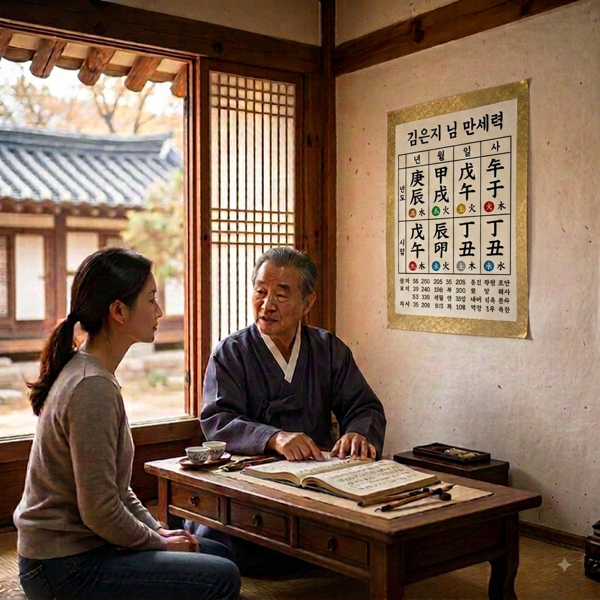
Saju (사주, saju) is a centuries-old Korean practice rooted in East Asian cosmology. It translates literally to "four pillars" — the year, month, day, and hour of your birth. Together, these pillars form eight characters (팔자, palja) that map the cosmic energy present at the exact moment you were born.
Unlike Western horoscopes that track planetary positions, Saju is built on the sexagenary cycle — a system of 10 Heavenly Stems and 12 Earthly Branches that has been used across East Asia for thousands of years.
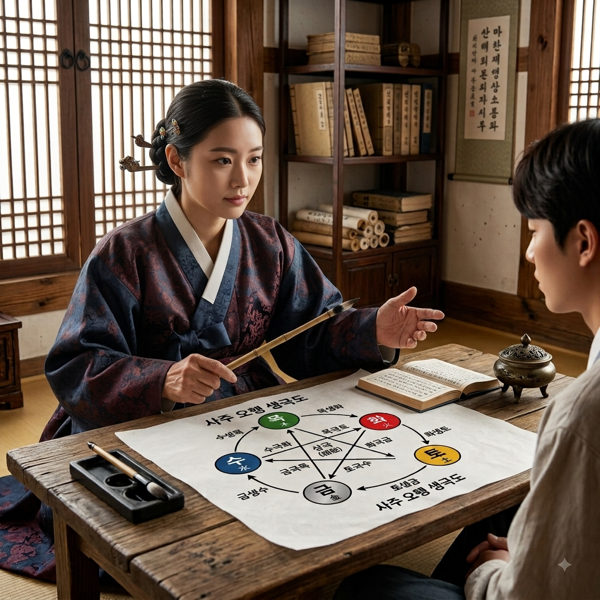
The Five Elements
At the heart of Saju are the Five Elements — Wood, Fire, Earth, Metal, and Water. The balance between them shapes your personality, strengths, and challenges.
- 🪵 Wood — Growth, creativity, compassion
- 🔥 Fire — Passion, expression, warmth
- 🏔️ Earth — Stability, reliability, nurturing
- ⚔️ Metal — Precision, determination, principles
- 💧 Water — Wisdom, adaptability, intuition
Your Day Master
The most important element in your chart is the Day Master (일간, ilgan) — the Heavenly Stem of your Day Pillar. It represents your core self. All other elements are read in relation to it.
The History of Saju
Saju traces its roots to ancient China's Ming Li Xue (命理學, the study of fate), which emerged over 2,000 years ago during the Han Dynasty. The system was formalized during the Tang and Song Dynasties, when scholars like Xu Ziping refined the Four Pillars method into what we recognize today.
Korea adopted and adapted this tradition centuries ago, weaving it into its own culture under the name 사주명리학 (Saju Myeongnihak, saju myeong-ni-hak). In Korea, saju became deeply embedded in daily life — traditionally consulted for marriages, naming children, business decisions, and major life events. Even today, millions of Koreans check their saju regularly.
While China calls it BaZi (八字) and Japan has its own variation, Korea's interpretation tradition has its own distinct flavor — more emphasis on practical life guidance and a warmer, more personal reading style.
Saju vs. Horoscopes, Tarot & Other Systems
How does Saju compare to the divination systems you might already know?
| Based on | Changes? | |
|---|---|---|
| Saju 사주 | Birth date & time | Fixed at birth |
| Horoscope | Sun/planet positions | Daily/weekly |
| Tarot | Card draw (random) | Every reading |
| MBTI | Self-reported quiz | Can change |
| Numerology | Birth date numbers | Fixed at birth |
The key difference: Saju is deterministic — your chart is calculated, not interpreted subjectively. Two Saju readers given the same birth data will produce the same chart. The interpretation varies, but the underlying data doesn't.
Do I Need My Birth Time?
Your birth time determines the Hour Pillar — the fourth pillar. Without it, you still get a meaningful three-pillar reading. Saju uses two-hour blocks rather than exact minutes, so even an approximate time is useful.
Ready to see what your Four Pillars reveal?

FAQ
What is Saju?+
Saju (사주) is the Korean Four Pillars of Destiny — a system that uses your birth date and time to create a chart of eight characters revealing your elemental balance and life tendencies.
How is Saju different from Western astrology?+
Western astrology tracks planetary positions. Saju maps the quality of time using the Five Elements and the sexagenary cycle — a fundamentally different approach rooted in East Asian philosophy.
What is the Day Master?+
The Day Master (일간) is the Heavenly Stem of your Day Pillar — the element representing your core self. Everything else in your chart is interpreted in relation to it.
Do I need to know my birth time?+
No — you can get a meaningful reading with just your birth date. Birth time adds the Hour Pillar for a more complete chart.