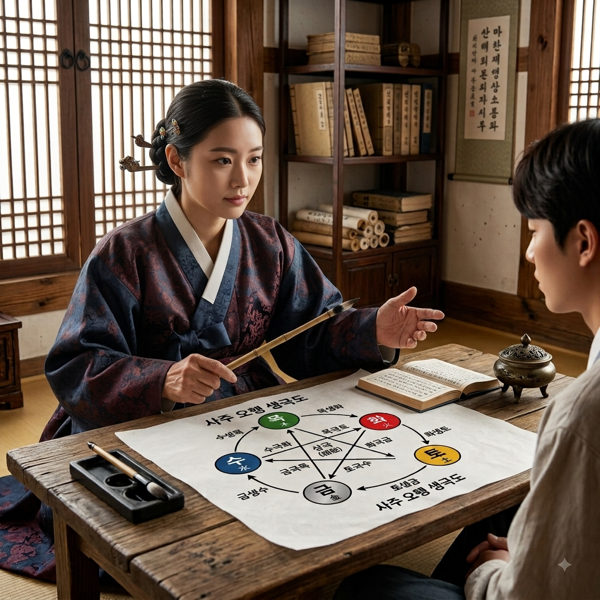
🌳 Wood (목, mok) is the energy of growth, creativity, and compassion — like a tree reaching upward. In your Saju chart, Wood shapes how you expand, create, and care for others. How much of it you carry — a lot, a little, or none — reveals where those qualities run strong and where they quietly need cultivating.
🌿 What Wood really means in Saju
Wood is the first of the Five Elements (오행) and stands for new growth — spring, sunrise, the green shoot pushing through soil. Its deeper theme is direction: the instinct to reach, learn, build, and push toward something larger than yourself. In the elemental cycle, Wood is fed by Water (rain grows the tree) and feeds Fire (wood becomes flame), while it's pruned by Metal (the axe) and breaks up Earth (roots splitting soil). Understanding those relationships is the key to reading your whole chart — an element never acts alone.
🌱 Wood isn't only about growing — it's about growing somewhere. Like a tree that always finds the light, Wood people carry an inner compass pointing toward purpose.
🌲 갑 vs 을 — the two faces of Wood
Wood shows up in two very different flavors, and knowing which you carry changes the reading. Yang Wood (갑, gap) is the tall tree — upright, principled, ambitious, sometimes inflexible. Gap people lead from the front and stand by their convictions, but they can struggle to bend when life demands it. Yin Wood (을, eul) is the vine, grass, or flower — adaptable, resourceful, charming, quietly persistent. Eul people don't force their way up; they wind around obstacles and find the light anyway. Same element, two strategies: the tree that stands firm, and the vine that always finds a way through.
🌳 The Wood personality
Strong-Wood people are usually visionary, principled, and warm. They think in terms of potential and growth, champion the causes and people they believe in, and have a natural instinct to mentor and uplift. In relationships, Wood loves by helping you become more — encouraging your goals, nudging you to grow — though that same instinct can tip into wanting to "fix" a partner. At work, Wood thrives where there's something to build from scratch, a mission to believe in, or people to develop. Like a tree, they're rooted in their values, which is a genuine strength — even if it can make them slow to compromise.
Best-Fit Careers
⚡ When you have too much Wood
An abundance of Wood can tip into stubbornness and over-idealism. Too many branches scatter the energy — lots of projects started, fewer finished — and the rootedness that gives conviction hardens into rigidity: difficulty changing course, taking feedback, or admitting a plan isn't working. Excess Wood can also mean over-giving: pouring so much into others' growth that your own goes untended. The classical remedy is Metal — structure, pruning, and the discipline to choose one direction and commit.
💡 The same rootedness that gives conviction can become rigidity. Too many branches, not enough fruit.
🍂 When Wood is weak or missing
Little or no Wood often shows up as trouble starting and a lack of clear direction — hesitation about which way to grow, low assertiveness, or difficulty taking the first step. It can feel like watching others chase goals while you wait for certainty that never quite arrives. This isn't a flaw so much as a muscle to build: setting concrete goals, learning new skills, spending time in nature, and giving yourself permission to reach all invite Wood energy in. People with missing Wood often find that one committed pursuit — a craft, a cause, a plant to tend — unlocks momentum everywhere else.
🩺 Wood, the body, and the season
In traditional East Asian thought, each element maps to the body and the calendar. Wood is linked to spring, the liver and gallbladder, and the emotion of anger — the pressure that builds when growth is blocked. People reading their charts for balance often lean into Wood's season and colors (green, the east, morning light) when they feel stuck or stagnant. Treat this as cultural context and self-reflection, not medical guidance.
⚖️ How to balance Wood
If Wood is excessive, borrow from Metal ⚔️ — structure, routines, pruning your commitments down to what matters. If Wood is lacking, feed it: greens and blues, the east direction, plants and time outdoors 🌿, morning rituals, and steady, curiosity-driven learning all nourish it.
Curious how much Wood your chart actually holds? Run your free Saju calculation.
🧭 Explore the other elements



🔍 Which elements are in your Saju?
Your Wood level — and the balance of all five elements — comes straight from your birth chart, not a guess.
FAQ
Is too much Wood bad?+
Not bad — it means strong drive and conviction. Just watch for stubbornness, over-giving, and too many unfinished projects.
What does missing Wood mean?+
Usually a growth mindset worth developing: direction, initiative, and the confidence to start before you feel ready.
What's the difference between 갑 (gap) and 을 (eul) Wood?+
갑 is Yang Wood — the tall, upright tree: principled and ambitious. 을 is Yin Wood — the vine or grass: adaptable, resourceful, and quietly persistent.
What color and direction belong to Wood?+
Blue-green, and the east. Spring is its season.
What weakens or controls Wood?+
Metal controls Wood (the axe prunes the tree), and Fire drains it (wood burns to feed flame). Water strengthens Wood.
This guide is for reflection and entertainment, not professional advice.